How to Focus While Praying
How to focus while praying when your mind wanders: use a gentle reset, one clear anchor, and a small practice you can repeat without shame.

If you are looking for how to focus while praying, start with a return rather than a fight. Notice where your attention went, set aside anything that truly needs remembering, and come back to one sentence or phrase. Focused Christian personal prayer is a repeatable practice of returning attention to God after distraction, not a state in which a wandering thought never appears.
The aim is not to create a perfect room, a perfect posture, or a perfect five minutes. The aim is to make the next return clear enough that you can pray in the room, body, and schedule you actually have.
How to focus while praying when your mind wanders
When your mind wanders during prayer, do not restart the whole prayer or scold yourself. Pause, name the distraction in a few words, decide whether it needs a note for later, and return to the last sentence or phrase you were praying. The return is the practice.
Noticing a thought is different from indulging it. A work call, a fear, or a sound from the next room can appear without your permission. A random thought is not automatically sin, a diagnosis, or proof that prayer has failed. The useful question is smaller: does this thought need one short note, or can I return now?
Use this four-step reset when you realize you have stopped praying:
- Pause. Stop adding words for one breath and admit that your attention moved.
- Name it. Say “work call,” “fear,” “noise,” or another short label. Naming keeps the thought from becoming an unnamed argument.
- Park it if it is actionable. Write “pay bill after prayer” on paper if you need a reminder. Do not solve the bill in your head.
- Return. Speak one line such as “Lord, help me be present,” or go back to the last phrase you were praying.
Imagine praying about a difficult family conversation when an unpaid bill comes to mind. Write “pay bill after prayer,” say “Lord, help me be present,” and continue. The bill still has a place in your day; it does not have to occupy the prayer as well.
Use the reset once today. Count the return—not uninterrupted concentration—as the completed action. Focus is rebuilt through repeated gentle returns, not achieved by forcing the mind never to wander.
Make the first minute easier to enter
Before prayer, remove one controllable distraction and choose one small cue: silence notifications or place the phone out of reach, keep paper nearby, and take a brief settling pause. Ideal silence is unnecessary; a clear next action makes returning possible in the circumstances you actually have.
Some distractions belong to the setup, while others belong to life. Separate the two before you decide what to change:
| Controllable distractions | Involuntary distractions |
|---|---|
| Notifications, open tabs, a phone in your hand, and visible chores | Children, neighbours, traffic, fatigue, and a shared household |
| Choose one to reduce before prayer | Make room to return when one appears |
Use a three-step setup:
- Choose the cue. Pick a real moment, such as after putting on the coffee or when a child settles. The cue should already exist in your day.
- Remove one friction point. Silence notifications, close one open tab, or put the phone across the room. Do one thing; do not build a ritual checklist.
- Leave an offramp. Put a notepad beside the chair so an unfinished task has somewhere to go.
A parent cannot remove every sound from the house. Placing a notepad beside the chair and praying for three minutes after the child settles is more workable than waiting for a silent house. Keep the rest imperfect. Preparation is selective friction reduction, not a demand for a perfect prayer room.
Give your attention one anchor when you get distracted while praying

Choose one anchor before you begin: a short phrase from the passage in front of you, one sentence spoken aloud, or one written request. When attention slips, return to that same anchor instead of searching for a new topic. The anchor supports prayer; it is not a formula that controls God or guarantees a feeling.
Matthew 6:6–13 and the Psalms offer biblical models of bringing words, needs, praise, and lament before God. The World English Bible, British Edition (WEBBE) renders Matthew 6:11 as “Give us today our daily bread.” The same one-phrase practice works whether your Bible uses WEBBE or Reina-Valera 1909. You do not need to study a whole passage during a distracted session.
| Anchor | When it helps | Short example |
|---|---|---|
| Verse phrase | The passage is already open and one line stands out | “Give us today our daily bread.” |
| Spoken sentence | Silent prayer keeps dissolving into unrelated thoughts | “God, help me bring today’s worry to you.” |
| Written line | Writing keeps your request concrete or speaking would disturb someone | “Help me act with patience in this conversation.” |
One stable anchor is more useful for a distracted session than a long list of requests or a search for the perfect verse. Write the anchor before prayer starts and use it for the whole short session. When a notification or worry interrupts, return to the same phrase instead of opening a new subject.
An anchor handles the prayer itself. An urgent practical thought needs a separate place so it can stop competing for memory.
Park urgent thoughts instead of arguing with them

When a distraction is a real task you are afraid to forget, keep a small sheet beside you and write only the word or short phrase needed to remember it. Then return to prayer. Parking a thought is not ignoring it or giving it control; it removes the pressure to rehearse it while you pray.
Use this short protocol:
- Capture one keyword. Write “Email landlord,” not the email, its background, and three possible replies.
- Add a review cue. Write “4pm” or “after lunch,” so the note has a later place in your day.
- Return to the anchor. Say the next sentence of your prayer or repeat the phrase you chose before beginning.
- Review after prayer. Let the note wait until the cue arrives. Do not turn the prayer into a planning session.
| Capture the thought | Follow the thought |
|---|---|
| “Email landlord — 4pm” | Drafting the email while prayer is still open |
| One reminder with a later cue | A new to-do list, schedule, or mental rehearsal |
| Protects the prayer and the responsibility | Keeps both competing for attention |
A one-line capture protects both responsibilities: prayer can continue, and the task has a next place to go. If the thought reflects serious or persistent distress rather than a practical reminder, bring it to a trusted person or qualified professional as well as praying. Put paper and pen within reach, and choose the review time before starting.
With an offramp available, you can choose a prayer mode that matches your body and room instead of forcing silent stillness.
Change the prayer mode when silence keeps failing
Silent prayer is not the only valid way to stay focused. If silent prayer makes your attention disappear, try speaking quietly, writing a few lines, walking slowly, or praying with another trusted person. These are forms of prayer, not tests of spiritual maturity. Choose the mode that keeps you honestly addressing God and still lets you return when your mind moves away.
| Prayer mode | What it offers | Boundary to respect |
|---|---|---|
| Silent | Privacy and a low-friction beginning | Noise and internal thoughts remain part of the setting |
| Spoken | A sentence you can hear and follow | Keep your voice quiet when others are sleeping or nearby |
| Written | A visible line for a request or response | Write a few lines, not a new journal assignment |
| Walking | Gentle movement and a familiar route | Choose a safe route where you can give attention to your surroundings |
| Shared | Another trusted person helps hold the time | Agree on privacy and the length of the prayer beforehand |
Someone who drifts while sitting silently might speak one sentence aloud while walking a familiar, safe route. Someone else might write because speaking would wake the household. Neither person needs to copy the other. Test one alternate mode for one short session and keep the one that makes returning easier.
A change of mode can make attention more available without turning prayer into a performance. No posture, soundtrack, breathing pattern, or app setting guarantees concentration. The useful test is whether the mode helps you address God honestly and return after distraction.
The final step is to combine one mode, one anchor, and one return cue into a practice small enough to repeat.
Build a five-minute prayer reset you can repeat tomorrow
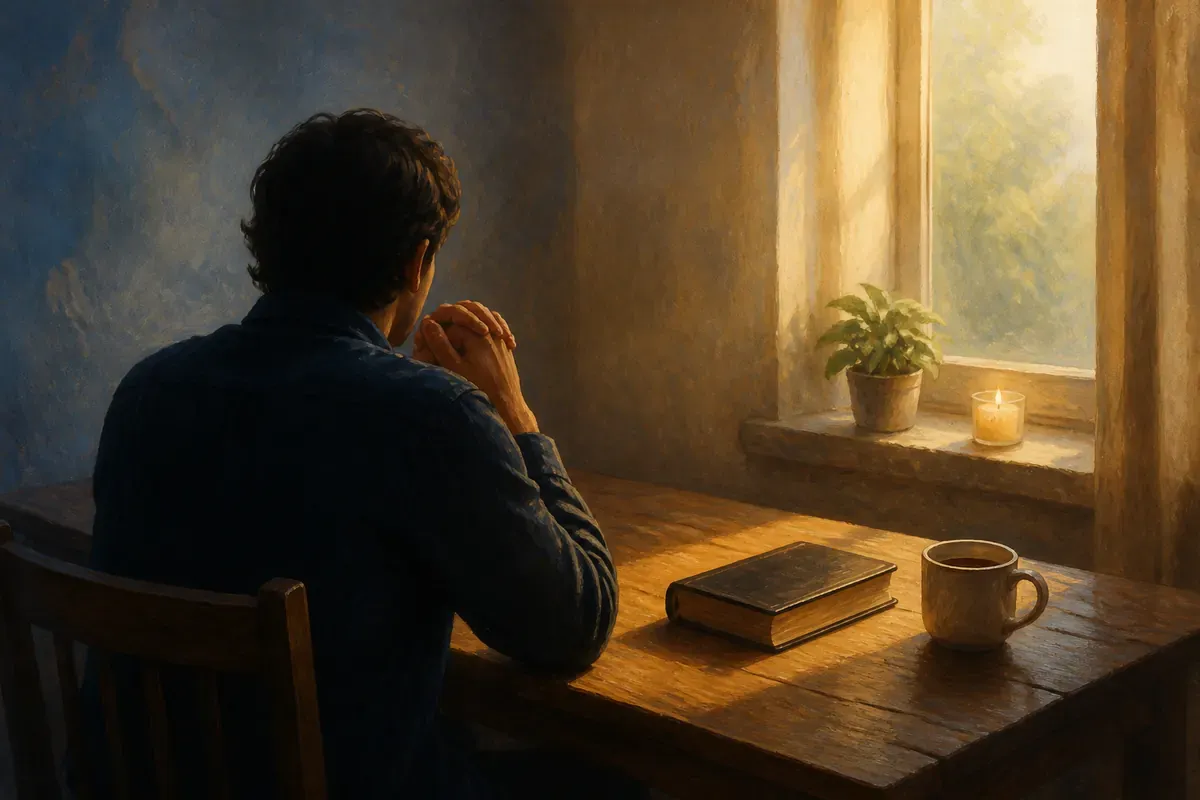
Set a small time boundary, choose one anchor, pray until the first distraction, use the pause–park–return reset, and finish without grading the session. A five-minute prayer can include several returns and still be complete. The goal is a repeatable meeting with God, not a perfect attention score.
Try this sequence:
- 0:00 — Settle. Silence one distraction, place the phone out of reach, and sit, stand, or walk in the mode you chose.
- 0:30 — Choose the anchor. Read a short passage already in front of you or select one phrase.
- 1:00 — Answer honestly. Speak or write one sentence about what you are bringing to God today.
- During the session — Return. When attention moves, pause, name the thought, park a practical task, and return to the anchor.
- 4:30 — Close. Finish with thanks or release what you cannot carry into the next part of the day.
- 5:00 — Note the next cue. Choose when tomorrow’s prayer can begin. Do not compensate for a missed day with a longer prayer.
| Your setting | Five-minute version |
|---|---|
| Calm morning | Pray after coffee, keep the phone away, and use one verse phrase as the anchor. |
| Rushed lunch break | Put the phone out of reach, speak one honest sentence, and use the reset when the first task appears. |
| Noisy house at night | Pray aloud for two minutes or write quietly, then stop after one genuine return rather than waiting for perfect silence. |
The practice does not become more faithful by becoming longer. Start the five-minute version at the next existing cue. If the session is scattered, count the return as enough and continue at the next cue without adding pressure.
Once the practice has a shape, a daily verse can provide the next concrete starting point without replacing your own prayer.
Let a daily verse be the next return point
A daily verse can give a distracted prayer one visible starting point: read one short passage, choose one phrase, answer it in your own words, and return to that phrase when attention slips. A daily verse removes one decision from the beginning; it cannot guarantee focus, replace prayer, or promise a particular spiritual outcome.
Use the loop in four actions:
- Read the verse. Let one short passage be the thing you see when prayer begins.
- Choose the phrase. Select one line rather than trying to hold the whole passage in memory.
- Speak an honest sentence. Answer the phrase with your own words and today’s real concern.
- Return. When your mind wanders, come back to the same phrase once before closing.
When we designed Bible: Daily Verse & Prayer, we kept a daily verse followed by a personalized prayer as the opening cue. Choose one phrase, answer it in your own words, and use that same phrase as the return point when your mind wanders.
The app offers a choice of Catholic or evangelical tradition. Local reminders and the Home Screen widget put the cue in sight. History in the altar and saved readings give you a place to recover a passage later, while sharing and offline use are adjacent reading capabilities. None of these functions does the praying for you or promises concentration.
The same loop works with a Bible you already own or with a daily-verse tool.
If the obstacle is not distraction but not knowing what to say, how to pray when you don’t know what to say can help you begin with one verse and an honest sentence. A guide to praying Scripture as a response explains how to turn a verse into a prayer.
A Home Screen widget can put a verse cue in a visible place; how to add a Bible verse widget to your Home Screen covers that separate setup. Choose the phrase before your next prayer, and keep your own words central.
FAQ
Is it normal to get distracted while praying?
Yes. A wandering thought is a common part of prayer and is not, by itself, proof that your faith is weak or that the prayer failed. Notice it, capture an actionable reminder if needed, and return to one sentence or phrase without turning the interruption into self-criticism.
How do I stop my mind from wandering when I pray?
You cannot stop every wandering thought, but you can make returning easier. Remove one controllable distraction, choose one anchor, keep paper for urgent reminders, and use a short pause–park–return reset whenever you notice that your attention has moved.
What should I do when an important thought comes during prayer?
Write a brief keyword and a later review cue, then return to prayer. “Call the doctor after lunch” is enough; do not solve the task in the prayer session. If the thought reflects serious or persistent distress, bring it to a trusted person or qualified professional as well as praying.
Is it better to pray out loud to stay focused?
No single mode is best for every person. Speaking aloud can keep one person engaged, while silent, written, walking, or shared prayer fits another person better. Choose the mode that lets you address God honestly and return after distraction; no single posture or volume level guarantees concentration.
Keep reading
-

How Long Should I Pray Each Day?
How long should I pray each day? See what Scripture does—and does not—set, then build a prayer rhythm you can return to without guilt.
-

How to Pray Scripture: A Simple Guide
Learn how to pray Scripture: read a short passage in context, turn its words into honest prayer, and respond without treating the verse as a formula.
-

How to Start Praying Again as a Christian
Learn how to start praying again as a Christian after a long absence, with one honest sentence and a small rhythm you can return to.